OEM vs. Aftermarket Heavy Equipment Parts: How to Choose
TL;DR
OEM or aftermarket for your excavator, loader, or crane? A practical breakdown of cost, fit, and warranty trade-offs to help you decide part by part.
It isn't one decision — it's a different call for every part
"OEM or aftermarket" gets treated as a single fleet-wide policy, but the right answer usually changes part by part. A precision hydraulic pump and a cabin air filter don't carry the same risk if the fit is slightly off, and they shouldn't be bought with the same reasoning.
The real question for any given part is: what happens if this one doesn't perform exactly like the original? For some components the answer is "nothing much." For others it's downtime, a voided warranty, or damage to something more expensive than the part itself.
Where OEM earns its price
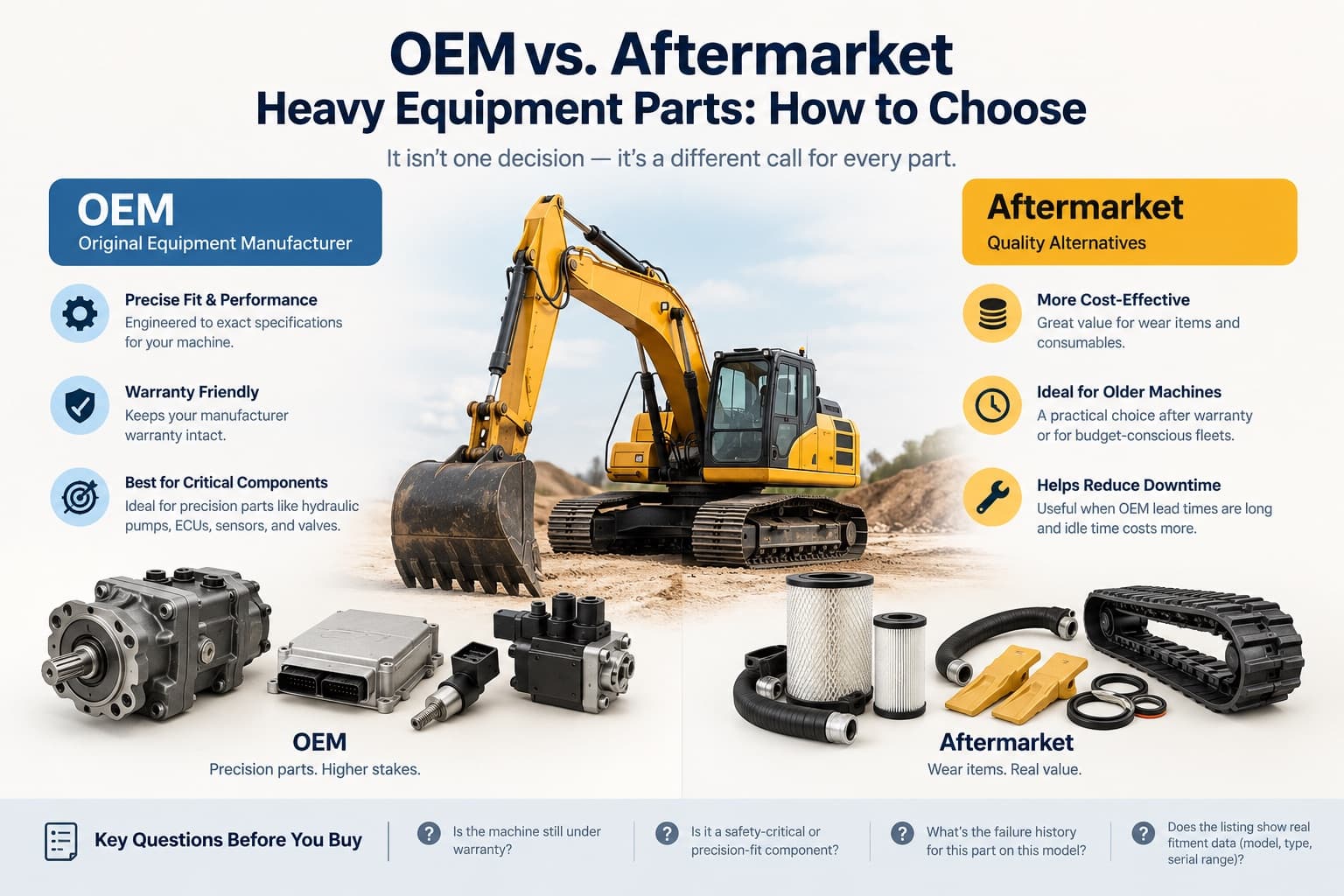
Precision-fit assemblies — hydraulic pumps and valves, electronic control modules, sensors — are engineered to tight tolerances specific to that machine's spec. A close-but-not-exact aftermarket equivalent can still bolt on and still cause premature wear, inconsistent pressure, or an intermittent electrical fault that's expensive to diagnose later.
OEM is also the safer default on a machine still under manufacturer warranty. Some warranty terms are voided or contested by using non-OEM parts on covered systems, so the part's sticker price isn't the only cost being compared.
Where aftermarket makes sense
Wear items with looser tolerance — filters, hoses, seals, ground-engaging tools, undercarriage wear parts — are exactly where quality aftermarket parts do their job well and cost meaningfully less. These are designed to be replaced on a schedule, not engineered to razor-thin tolerances.
Aftermarket is also the practical choice once a machine is well past its warranty period, for budget-constrained fleets running many older units, and when OEM lead times stretch out and a machine sitting idle costs more than the price difference between the two options.
Questions worth asking before buying either
Is the machine still under warranty, and does this system fall under it? Is this a safety-critical or precision-fit component, or a scheduled wear item? What's the actual failure history for this part on this specific model — not just "parts fail sometimes," but this part on this machine? And does the listing show real fitment data — model, machine-type, and ideally serial range — rather than a generic "fits most excavators" claim?
Related