How to Identify Your Excavator's Part Number
TL;DR
Where to find OEM part numbers on Komatsu, Hitachi, CAT, and JCB machines before you order a replacement.
Why the plate matters more than the model name
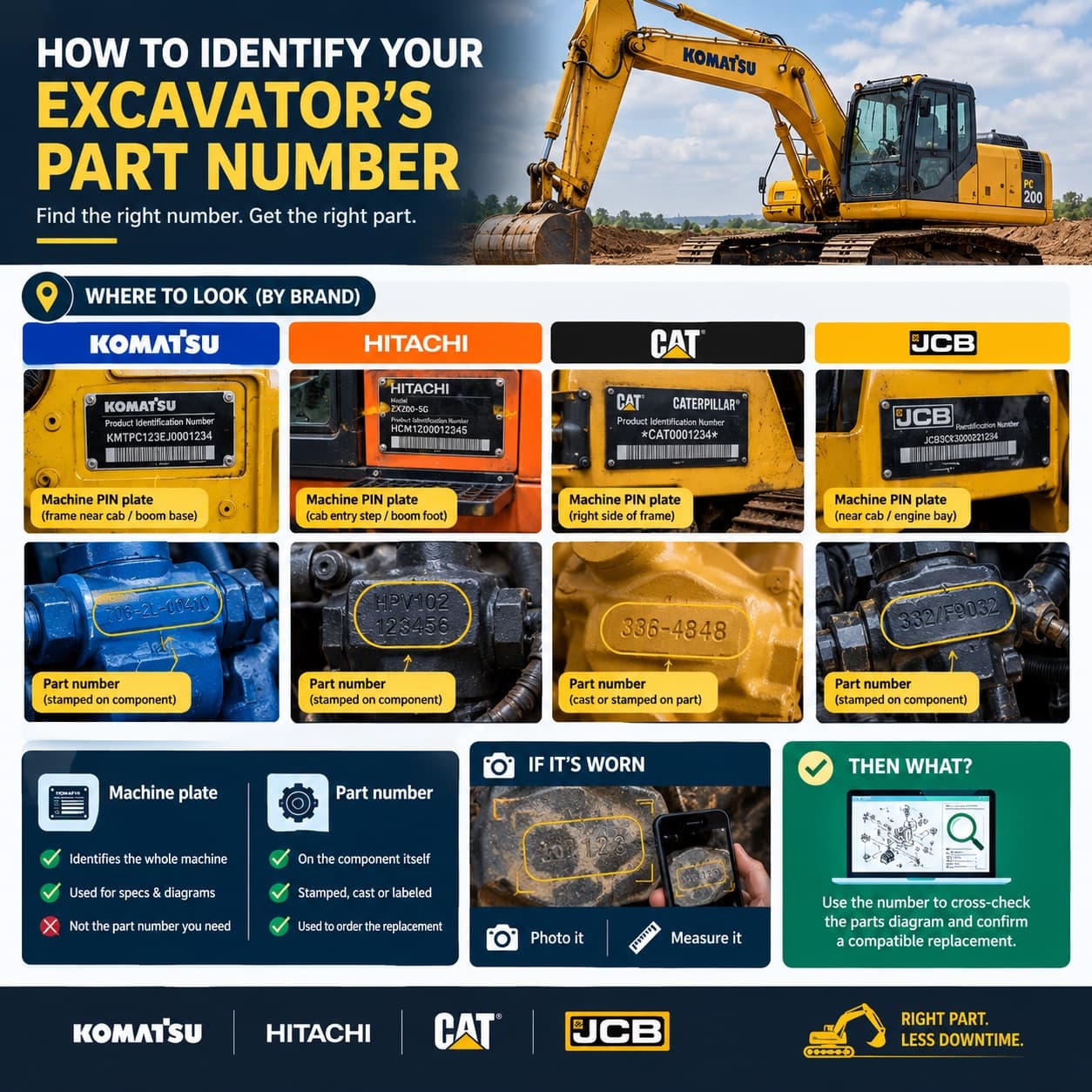
The machine's model name alone isn't a full identifier — specs commonly change mid-production run, so two excavators with the same model name can need different parts. Most major components — hydraulic pumps, engines, final drives, control valves — carry their own identification number stamped, cast, or labeled directly on the part, separate from the machine's own serial plate. That component number is what actually determines fit.
Where to look, by brand convention
Exact placement varies by model year, but the general convention holds across brands. On Komatsu machines, the machine's PIN (product identification number) plate is commonly on the frame near the cab or boom base, and individual component numbers are usually stamped or cast directly onto that component's housing. Hitachi and Tata Hitachi machines typically carry the serial plate near the cab entry step or the boom foot pin, with the same stamped-on-the-part convention for components. Caterpillar's PIN plate is commonly found on the right-hand side of the frame, often near the boom base or cab structure, with part numbers machined or stamped onto a flat face of the casting. JCB machines usually have the serial plate on the chassis near the cab or engine bay, with component numbers stamped on the housing the same way.
The machine's plate vs. the part's own number
The machine's serial or PIN plate identifies the machine as a whole — useful for pulling up the factory spec sheet or parts diagram for that unit. It is not the same as the number you need to order a specific replacement part. For that, find the number on the component itself: stamped into metal, cast into the housing, or on an attached label, not on the machine's own ID plate.
If the number is worn or unreadable
Note the number's exact position and orientation before it fully wears away, and photograph it — even a partially legible number narrows things down significantly. As a fallback, physically measure the part (bolt pattern, port sizes, shaft diameter) and cross-check it against the parts diagram for that machine's model and serial range in its manual, since a number's location on a given part stays consistent across a production run even when the marking itself has worn off.
What to do once you have the number
Once you have the actual number off the part, the next step is turning it into a confirmed compatible replacement — see our guide on cross-referencing an OEM part number below.