Excavator Hydraulic Pump Guide: Failure Signs & How to Pick a Replacement
TL;DR
How to recognize a failing excavator hydraulic pump before it strands the machine, and what to check before ordering a replacement.
What the hydraulic pump actually does
The hydraulic pump converts the engine's mechanical power into the hydraulic flow and pressure that drives almost everything on an excavator — boom, arm, bucket, swing, and travel. That's why pump problems rarely stay isolated to one function; when the pump itself is degrading, several systems tend to weaken together rather than just one.
Early warning signs
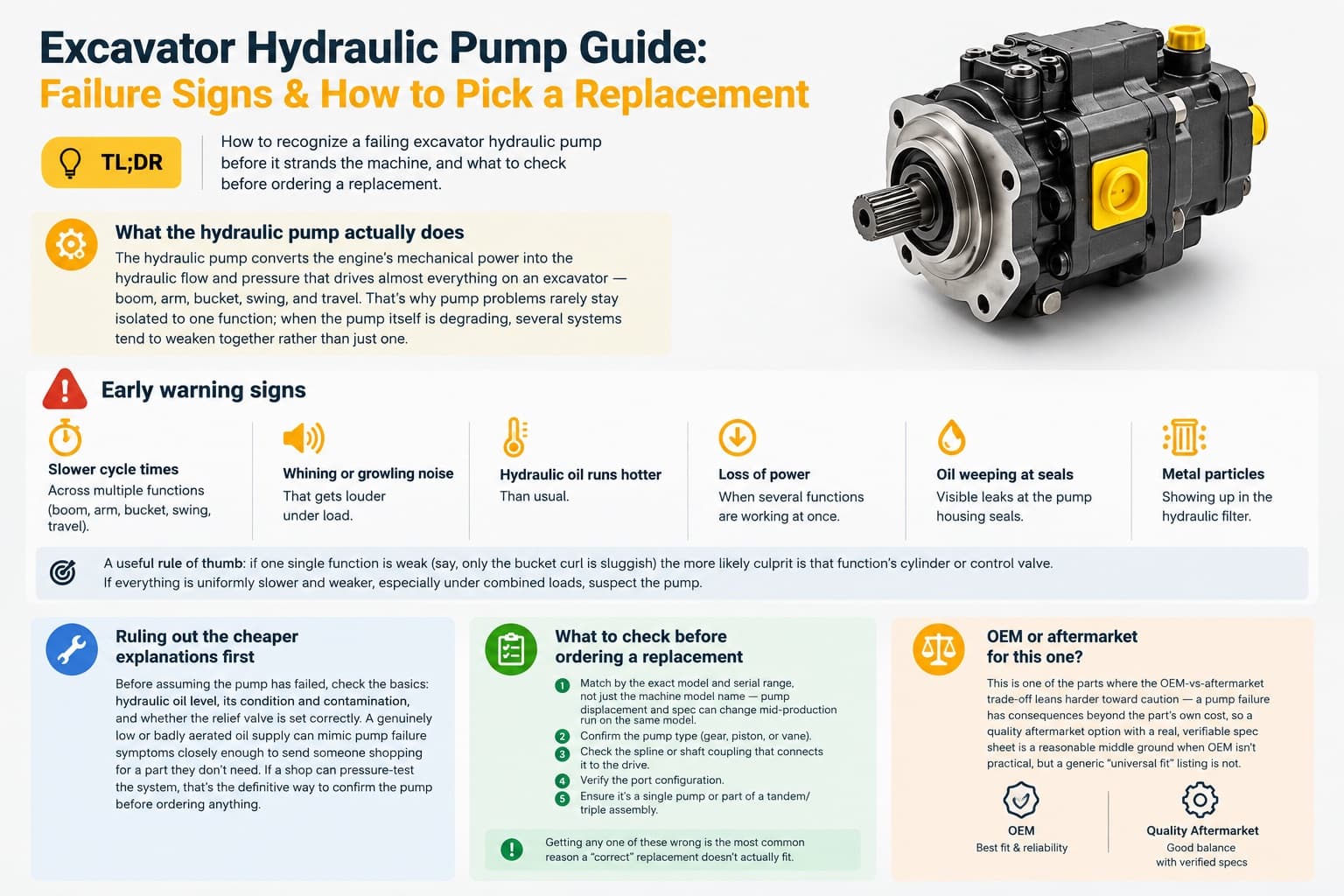
Slower cycle times across multiple functions, a whining or growling noise that gets louder under load, hydraulic oil running hotter than usual, and a general loss of power when several functions are working at once are all classic early signs. Visible oil weeping at the pump housing seals and metal particles showing up in the hydraulic filter are later-stage warnings that shouldn't be ignored.
A useful rule of thumb: if one single function is weak (say, only the bucket curl is sluggish) the more likely culprit is that function's cylinder or control valve. If everything is uniformly slower and weaker, especially under combined loads, suspect the pump.
Ruling out the cheaper explanations first
Before assuming the pump has failed, check the basics: hydraulic oil level, its condition and contamination, and whether the relief valve is set correctly. A genuinely low or badly aerated oil supply can mimic pump failure symptoms closely enough to send someone shopping for a part they don't need. If a shop can pressure-test the system, that's the definitive way to confirm the pump before ordering anything.
What to check before ordering a replacement
Match by the exact model and serial range, not just the machine model name — pump displacement and spec can change mid-production run on the same model. Confirm the pump type (gear, piston, or vane), the spline or shaft coupling that connects it to the drive, the port configuration, and whether it's a single pump or part of a tandem/triple assembly. Getting any one of these wrong is the most common reason a "correct" replacement doesn't actually fit.
OEM or aftermarket for this one?
This is one of the parts where the OEM-vs-aftermarket trade-off leans harder toward caution — a pump failure has consequences beyond the part's own cost, so a quality aftermarket option with a real, verifiable spec sheet is a reasonable middle ground when OEM isn't practical, but a generic "universal fit" listing is not.
Related